A hotel relies on clean linen, and at each checkout, used sheets, towels, and robes enter a cycle that must finish before the next arrival. Housekeeping has to wait for new supplies and schedule around another company’s trucks if an outside vendor controls these processes. Many hotels now choose to do this work in-house, and success depends on precise planning and the right hotel laundry equipment.
This guide covers every step, from calculating linen volume to selecting dryers and finishers. It is based on the experience of Consolidated Laundry Machinery (CLM), a manufacturer of industrial laundry equipment based in Pomona, California. CLM has provided laundry systems for hotels, hospitals, industrial laundries, apparel manufacturing, and correctional facilities since 1961. We aim to help clients get laundry equipment that keeps up with their hotel’s occupancy rate and doesn’t fail after installation.
How CLM Hotel Laundry Equipment and Support Keep Linen Moving From Day One
Consolidated Laundry Machinery (CLM) manufactures hotel laundry equipment in Pomona, California. The lineup centers on industrial tumble dryers from 250 to 1,200 lbs, in gas-heated or steam-heated models. CLM equips all dryers with upgraded Low NOx burners. Flexible door, control, and exhaust options help each dryer fit the room it serves. For finishing, the SPF 1 small piece folder stacks towels to set counts, while CLM vacuum feeders speed up ironing. Mat rollers serve properties that clean mats in-house. Support continues after installation. CLM provides service, replacement parts, on-site refurbishing, and training programs. Training helps teams run hotel laundry machines safely. The same support serves hospitals, industrial laundries, and correctional facilities.
What an On-Premise Laundry Changes for Housekeeping and Guests
On-premise laundry facilities allow hotels to control their schedule. Housekeeping staff don’t have to wait for delivery; they can rewash a stained sheet much faster, and the hotel controls factors such as wash chemistry, drying temperature, and fold quality.
Outsourcing also has benefits, such as no capital investment in laundry equipment and freeing up space for other uses, but it also creates a dependency on another company that might have its peak season at the same time as the hotel.
Several factors should be evaluated before making a decision:
Volume of linen: steady volume means that the costs of equipment will be distributed among a larger amount of laundry;
Free space: the laundry facility requires space for sorting, washing, drying, folding and storage;
Utilities: gas or steam, electricity, water, and exhaust are necessary for the proper functioning of industrial laundry equipment;
Equipment staff: someone will have to operate, clean, and maintain the laundry machines;
Equipment lifespan: Industrial laundry equipment is used constantly, and its costs are distributed over many years of operation;
The risk of waiting shows up at the worst time. A vendor delay during a sold-out weekend leaves rooms unsellable until linen arrives.
Every hotel laundry project goes smoother with an early plan. Talk with CLM about a new hotel laundry before the design is final.
In-House vs Outsourced Hotel Laundry: A Side-by-Side Comparison
Neither model wins for every property. The right choice depends on volume, space, and how much control the hotel wants over linen. This comparison lays out the trade-offs owners and general managers weigh most often.
| Factor | In-house laundry | Outsourced laundry |
| Turnaround | Set by the hotel’s own schedule | Set by vendor routes and pickup times |
| Upfront cost | Equipment, installation, and utility work | Little or none |
| Ongoing cost | Labor, utilities, maintenance, and parts | Per pound or per piece fees |
| Linen quality | Hotel controls chemistry, heat, and folding | Depends on vendor standards |
| Linen inventory | Smaller par levels often work | More linen sits in transit |
| Space | Requires a dedicated laundry room | Frees up floor space |
| Peak season risk | Capacity planned around the hotel’s own peaks | Vendor capacity tightens for every client at once |
Many properties use a hybrid model. They handle guest room linen in-house and send out specialty items. Others begin with guest room linen only and add banquet linen in-house as their volumes increase.
No matter the model choice. Before making a decision, do the math. Gather vendor invoices and laundry costs, including weights and utility costs. Hard numbers will prevent disappointment down the road.
Measure Linen Volume Before Choosing On-Premise Laundry Equipment
Each laundry size calculation depends on one crucial factor: pounds of soiled linen per day. Estimating by room count is often misleading and can lead to undersized dryers or washers that can’t keep up. It is important to determine the actual weight of the soiled linen.
A reliable measurement process looks like this:
- Weigh soiled linen daily for at least two weeks, including a high occupancy period.
- Divide the total by occupied rooms to find pounds per occupied room.
- Add linen from restaurants, banquets, spa, pool, and fitness areas.
- Add staff uniforms if the hotel plans to process them in-house.
- Plan for peak demand, not the yearly average.
Next, decide how many hours the laundry will run each day. A laundry running two shifts needs less hourly capacity than one running a single shift. That tradeoff shapes both the equipment list and the labor budget.
| Planning input | Where to find it |
| Pounds per occupied room | Two weeks of daily linen weights |
| Peak occupancy | Property management system reports |
| Food and beverage linen | Banquet and restaurant schedules |
| Operating hours | Staffing plan for the laundry |
| Growth plans | Renovation or expansion timeline |
Skipping this step is the most expensive shortcut in hotel laundry planning. Undersized equipment forces overtime from the first busy season. Turning those weights into machine sizes takes a few more steps. Our hotel laundry capacity calculation works through each one, with a worked example for a 400-room property.
Design a Laundry Room Where Linen Flows One Way
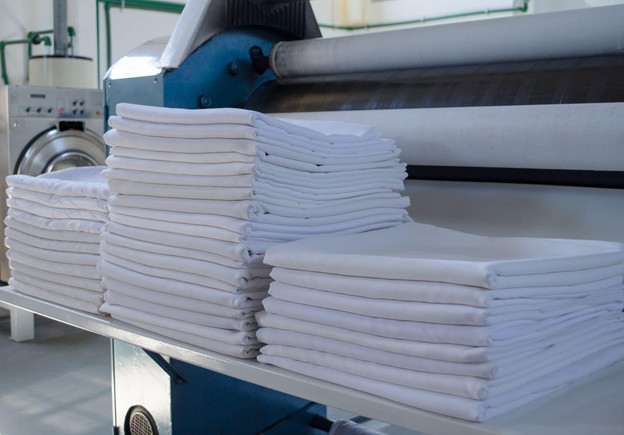
A good laundry layout moves linen in one direction. Soiled linen enters on one side, and clean linen leaves on the other. This flow keeps clean goods away from soiled carts and cuts wasted steps for staff.
Map the workflow zones
- Soiled receiving and sorting
- Washing and extraction
- Drying
- Folding, ironing, and finishing
- Clean storage and dispatch to housekeeping
Two-door pass-through dryers support this flow. Staff load from the wash side and unload on the finishing side. CLM industrial dryers come in one-door and two-door configurations with one-way or two-way tilt.
Confirm utilities early
Utility work often takes longer than equipment delivery. Settle these items during design, not after the order:
- Heat source: CLM builds both gas-heated and steam-heated dryer models.
- Electrical service: Requirements vary by model and options, so request exact specifications from CLM.
- Exhaust and makeup air: Dryers need clear exhaust routes and enough fresh air to run properly.
- Lint collection: Reserve space for a lint collector near the dryer exhaust path.
- Floor strength: CLM’s site lists industrial dryer weights between 7,000 and 10,000 lbs.
- Access route: Doors and corridors must fit the machines during delivery.
CLM also offers flexible layouts that can lower installation work. The control panel can sit on either side of the dryer. Exhaust ducting can exit at the front or rear. Two dryers with opposite control sides can share closer utility runs, which simplifies tight equipment rooms.
One conversation can cover dryers, finishing equipment, and long-term support. Request a hotel laundry equipment consultation with the CLM team.
Balance the Hotel Washer and Dryer Setup From Day One
Hotel laundry machines should be chosen as a system, not one at a time. A fast washer adds nothing if wet linen sits waiting for a dryer. A large dryer wastes fuel if it runs half full.
Balance the hotel washer and dryer pairing
Drying takes more time than washing. As a result, the dryer is the most common constraint in a hotel laundry. Provide sufficient dryer capacity to handle all washer loads without causing a backlog.
- Match total dryer capacity to total washer output per hour.
- Fill dryers to their recommended capacity for even drying.
- Size machines so towels and sheets can run as separate loads.
- Leave room for one more machine if the hotel plans to grow.
Think about redundancy
A single large dryer is a single point of failure. Two smaller machines allow continued laundry service when one requires maintenance. Many hotels opt for two matching dryers for this reason.
The CLM focuses on the drying and finishing side of the laundry. Since the hotel procures washers separately, the planning team should size both from the same linen data. Spin speed is the detail most planning teams overlook. Linen that leaves the washer wetter spends longer in the dryer, so washer extraction speed shapes drying cost more than the burner does.
Pick the Dryer That Will Carry the Workload for Decades
The dryer is the hardest-working piece of hotel laundry equipment. It runs load after load, often across two shifts. That duty cycle calls for a true industrial machine, not a lighter unit pushed past its limits.
CLM builds high-capacity industrial tumble dryers with recommended capacities from 250 to 1,200 lbs dry weight. The lineup below comes from CLM’s dryer models page.
| CLM model | Recommended capacity (lbs dry weight) | Heat source |
| 105 | 250 | Gas or steam |
| 140 | 350 | Gas or steam |
| 165 | 450 | Gas or steam |
| 194 | 600 | Gas or steam |
| 264 | 800 | Gas or steam |
| 321 | 1,200 | Gas |
Features that matter in a hotel setting
- Low NOx burners: CLM equips all dryers with upgraded low-NOx burners, helping properties in regions with strict air-quality rules.
- Tilting baskets: Tilt back to load and forward to unload, reducing heavy lifting.
- MicroCommand III controls: A color touch screen PLC manages drying cycles with a few simple push buttons.
- Gentle linen handling: Optional ceramic-coated basket panels and soft start drives protect goods and components.
- Variable speed: An optional two-stage variable speed basket drive adjusts tumbling to the load.
- Quieter operation: An optional sound reduction package helps when the laundry sits near guest areas.
- Multilingual controls: Controls are available in three languages for diverse laundry teams.
Emissions rules are tightening in many regions, and our look at how low-emission industrial dryers improve laundry plants covers what that means for a new install. Long service life also matters. CLM’s site estimates an industrial dryer life of roughly 30 years. That makes dryer selection a decision the hotel will live with for decades.
Gas or Steam: Choosing the Heat Source for Hotel Dryers
The heat source shapes installation cost, operating cost, and future flexibility. CLM builds gas-heated and steam-heated versions of most dryer models. The 1,200 lb model is available with gas heating.
When gas-heated dryers make sense
- The building already has a gas supply sized for industrial equipment.
- The hotel has no central boiler, or the boiler lacks spare capacity.
- The laundry needs to run independently of other building systems.
Gas dryers need proper combustion air and exhaust. Local air quality rules may also apply to burner emissions. The Low NOx burners on every CLM dryer, noted above, address this concern.
When steam-heated dryers work
- The hotel runs a central boiler with steam capacity to spare.
- Engineering staff already maintain steam systems.
- Ironers or other laundry equipment already use steam.
Questions to settle with the engineering team
- What utilities exist today, and at what capacity?
- Will the laundry grow, and can the chosen utility grow with it?
- Which local permits apply to gas burners or boiler loads?
- Who will maintain the heat system day to day?
Answering these early prevents ordering a dryer the building cannot support.
Each property needs a different capacity and heat source. Get help choosing the right CLM industrial dryer for the hotel’s linen volume.
Read our guide on How High-Capacity Dryers Optimize Floor Space and Utility Costs for industrial workflows for a better understanding.
Dryer Features That Help Linen Last Longer and Keep Staff Safe
Hotel linen is a recurring cost. Every snagged towel or torn sheet shortens the replacement cycle. Dryer design directly affects how long linen lasts.
Design details that protect linen
CLM dryer specifications highlight several features aimed at product care:
- Revolving basket door: The door seals to the basket and rotates with it. This removes the gap where linen can catch.
- Round basket perforations: Smooth, round openings help prevent damage to buttons and zippers on uniforms and robes.
- Heavy-gauge basket: A 10-gauge steel basket frame with removable perforated panels simplifies maintenance.
- Soft start and reversing: An inverter starts the basket slowly and reverses it gently, which reduces strain on goods and components.
Features that protect laundry staff
Large dryer loads are heavy, and repetitive lifting can cause injuries. Equipment choices can reduce that risk.
- Tilting baskets: Tilt back to load and tilt forward to unload, so gravity does much of the work.
- Pass-through loading: Two-door models separate the loading and unloading sides, which reduces crowding at one machine.
- Clear manual controls: Push buttons handle tilt and door position, and every control panel includes an emergency stop.
Safer equipment also supports retention. Laundry roles are hard to fill, and a less physical job keeps trained operators longer. Equipment is only half of it. Daily routines matter just as much, and several common drying habits shorten linen life without anyone noticing.
Add Finishing Equipment That Removes Bottlenecks
Folding and ironing are amongst the most laborious operations in a hotel laundry. Hand folding creates inconsistent stacks and delays housekeeping processes. Finishing equipment automates this stage.
Small piece folders for towels
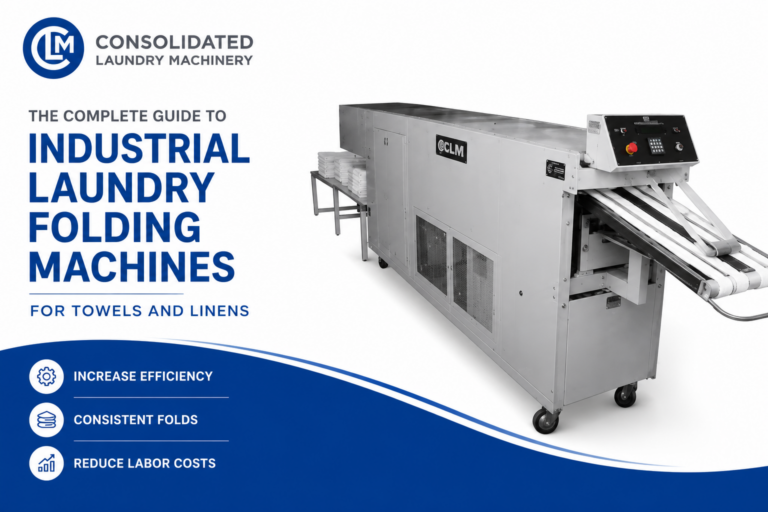
The CLM SPF 1 small piece folder automatically measures and French-folds to a set width, then stacks to a predetermined quantity. With a touch-screen PLC that stores up to 16 programmable formulas, the machine arrives on castors with a locking facility and includes electrical and air connections. It is a versatile addition to any existing hotel laundry room.
Vacuum feeders for ironed linen
Hotels with restaurants and banquet space process large volumes of napkins and tablecloths. Feeding these by hand into an ironer is slow and often leaves creases. CLM vacuum feeders spread and straighten linen as it enters the ironer.
- NapkinFaster: A five-lane feeder for napkins and small items. CLM reports up to 25% more small item production.
- VacFeed: Built for tabletops and other large pieces.
- FeedFaster: Built for sheets and other medium and large flatwork.
All three install on most existing ironers, so a hotel can add one without replacing its ironer.
Mat rollers for properties that process mats
Resorts and large properties that clean entrance mats in-house can add CLM mat rollers. These machines roll mats, clean automatically, and reduce staff strain.
How Hotels Use CLM Hotel Laundry Equipment Today
CLM equipment runs in city hotels, mountain resorts, and island properties across the U.S. These installations show how different hotels match equipment to their own linen needs.
| Hotel | Location | CLM equipment |
| The Ritz-Carlton, New Orleans | New Orleans, LA | Two new Model 105G dryers, 2026 |
| The Ritz-Carlton, Laguna Niguel | Dana Point, CA | Two CLM dryers, upgraded February 2024 |
| Boyne Mountain Resort | Boyne Falls, MI | New Model 165 dryer, 2022 |
| Arizona Biltmore | Phoenix, AZ | New Model 165 dryer, 2017 |
| Sands Regency | Reno, NV | SPF small piece folder |
| Bozeman Hot Springs | Bozeman, MT | SPF folder |
| Sheraton | Kauai, HI | SPF small piece folder |
Three patterns stand out from this list:
- Paired dryers: Both Ritz-Carlton properties run two CLM dryers. This setup keeps drying capacity available when one unit is down for service.
- Planned upgrades: The Laguna Niguel property upgraded its drying setup with two CLM dryers in 2024. Scheduled upgrades avoid a scramble after a breakdown.
- Folders as a standalone step: Several properties added a CLM small piece folder on its own. Finishing upgrades can happen without changing the dryers.
An aging dryer tends to fail at the worst possible moment. Discuss refurbishing and replacement options with CLM before peak season arrives.
Plan Service, Parts, and Training for OPL Laundry Equipment
The purchase price is only the start. OPL laundry equipment earns its value over decades, so the support plan deserves as much attention as the machine list. Ask about service, parts, and training before signing any order.
Preventive maintenance
In addition to the manufacturer’s preventive maintenance recommendations, CLM advises performing routine cleaning and inspection to keep laundry equipment in good working order. The CLM service department offers dryer diagnostics and repair services, as well as maintenance plan development. You can submit service requests by phone, email, or through the online form.
Replacement parts
Replacement parts for all CLM dryer models are available directly from CLM or through an authorized CLM dealer. Keeping a few wear parts on hand shortens repair time. The CLM parts page covers parts availability.
Operator training
CLM offers operator training programs to ensure safe, efficient equipment operation. Trained personnel know how to properly load laundry dryers and recognize irregularities in the process. In addition, these workers can perform routine tasks in a timely manner.
Conduct training sessions when new employees join the team, since the hotel industry often has a high turnover rate.
Refurbishing and upgrades
Older dryers do not always need full replacement. CLM provides refurbishing services and on-site dryer upgrades. Hotels can also consider CLM-certified remanufactured dryers when budgets are tight. Refurbishing extends equipment life and can delay the cost of a full replacement.
Replacing an Older Dryer in an Existing Hotel Laundry
Many hotel projects are not new builds. They start with an aging dryer in a cramped room designed decades ago. Planning replacements in this setting comes with its own challenges.
Match the existing footprint and utilities
Moving gas lines, steam lines, and exhaust ducts adds cost and downtime. CLM dryers can be configured to fit existing rooms:
- The control panel, burner, and blower can sit on the right or left side.
- Exhaust ducting can exit at the front or the rear of the dryer.
- These choices give more options for lint collector placement.
CLM also designed its Model 165 to fit the footprint of a widely installed older dryer. That approach can cut installation work in an existing wash aisle.
Common Hotel Laundry Planning Mistakes and Their Cost
Most laundry problems trace back to decisions made before installation. Each mistake below costs labor, linen, or guest satisfaction long after the project closes.
| Mistake | What happens | How to avoid it |
| Sizing by room count alone | Equipment falls behind during peak season | Weigh actual linen for two weeks |
| Undersized dryers | Wet linen piles up and overtime grows | Size dryers to absorb all washer output |
| One large dryer only | A single breakdown halts the laundry | Install two matched dryers |
| Late utility planning | Installation stalls and costs rise | Confirm gas, steam, power, and exhaust early |
| Ignoring finishing | Folding becomes the new bottleneck | Plan folders and feeders with the dryers |
| No support plan | Long waits for parts and repairs | Confirm service, parts, and training upfront |
Waiting carries its own risk. An aging dryer rarely fails on a quiet Tuesday. It tends to fail when every room is booked. Planning an upgrade now gives the hotel control over timing, budget, and downtime.
Build a Hotel Laundry That Keeps Pace With Occupancy
A well-designed laundry system relies on accurate analysis of linen needs and the appropriate support system. It includes balancing washers and dryers, preparing utilities and accessories, and adding equipment for labor-intensive laundry tasks. All of the above help reduce overtime, rewash, and linen stock-outs during peak times at a particular hotel.
CLM has manufactured industrial dryers since 1983 and has been in the industry since 1961. The company’s products, made at its Pomona, California, headquarters, include high-capacity dryers, small piece folders, vacuum feeders, and mat rollers. Hotels, hospitals, industrial laundries, apparel manufacturers, and correctional facilities use them.
Hotels comparing OPL equipment and hotel laundry equipment suppliers can contact CLM to review linen volume, space, and utilities. A planning conversation today costs far less than a laundry that falls behind next season.